


















India-US Civil Nuclear Deal: Crowning Glory Of Manmohan Singh's Leadership
India's epochal civil nuclear agreement with the United States in 2008 will remain a crowning glory for Manmohan Singh's prime ministership in the foreign policy domain.


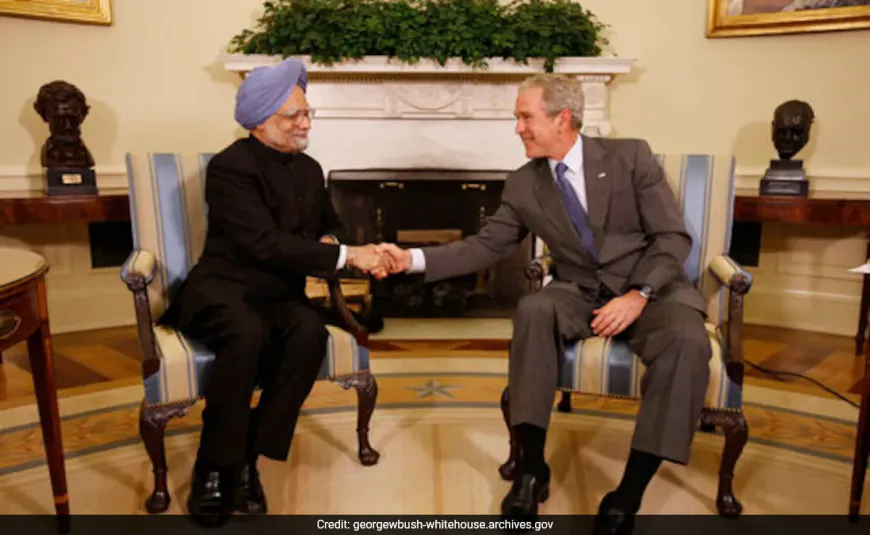

India's epochal civil nuclear agreement with the United States in 2008 will remain a crowning glory for Manmohan Singh's prime ministership in the foreign policy domain as it not only ended the country's nuclear apartheid but created a favourable geopolitical configuration.
Dr Singh, the then prime minister, was so convinced about the futuristic outcomes of the historic deal he showed steely determination to push it strongly though the survival of his government was at stake during a no-confidence vote in Parliament.
The civil nuclear deal changed India's overall engagement with the US as it paved the way for building the bonds of a strategic partnership, especially in areas of high-technology and defence.
In July 2005, India and the US announced that they would cooperate in civil nuclear energy following Dr Singh's talks with then American President George W Bush.
In an address at a joint session of the US Congress on July 19, Dr Singh elaborated on the need for India-US collaboration in the civil nuclear energy sector and explained New Delhi's impeccable record in nuclear non-proliferation.
"We have adhered scrupulously to every rule and canon in this area. We have done so even though we have witnessed unchecked nuclear proliferation in our own neighbourhood which has directly affected our security interests," he had said.
"This is because India, as a responsible nuclear power, is fully conscious of the immense responsibilities that come with the possession of advanced technologies, both civilian and strategic," Dr Singh said.
"We have never been, and will never be, a source of proliferation of sensitive technologies," he said.
Following a series of negotiations, the IAEA approved the safeguards agreement with India on August 1, 2008 following which the US approached the Nuclear Suppliers Group (NSG) to grant a waiver to New Delhi to commence civilian nuclear trade.
The NSG granted the waiver to India on September 6, 2008, allowing it to access civilian nuclear technology and fuel from other countries.
The agreement was signed by then External Affairs Minister Pranab Mukherjee and his US counterpart Condoleezza Rice, on October 10.
Following the deal, India's overall strategic cooperation with the US witnessed a major upswing.
Dr Singh's tenure as the prime minister in the first UPA government also saw better relations between India and Pakistan, a phase that began in 2004 with then Prime Minister Atal Bihari Vajpayee at the helm.
However, it changed following the terror attack in Mumbai in November 2008.
Dr Singh died at the All India Institute of Medical Sciences (AIIMS) in Delhi on Thursday. He was 92.
(Except for the headline, this story has not been edited by NDTV staff and is published from a syndicated feed.)